

What Every Trader Should Know
Why markets react unexpectedly is one of the most common questions traders ask when financial markets move in ways that seem to contradict the news. Every day, financial markets respond to economic reports, central bank announcements, political developments, and global events. Yet sometimes these reactions appear confusing.
Strong economic data can cause stock markets to fall. Weak economic reports can trigger market rallies. A single comment from a political leader, central banker, or government official can send currencies, commodities, and indices moving within minutes.
To many traders, these reactions appear unpredictable.
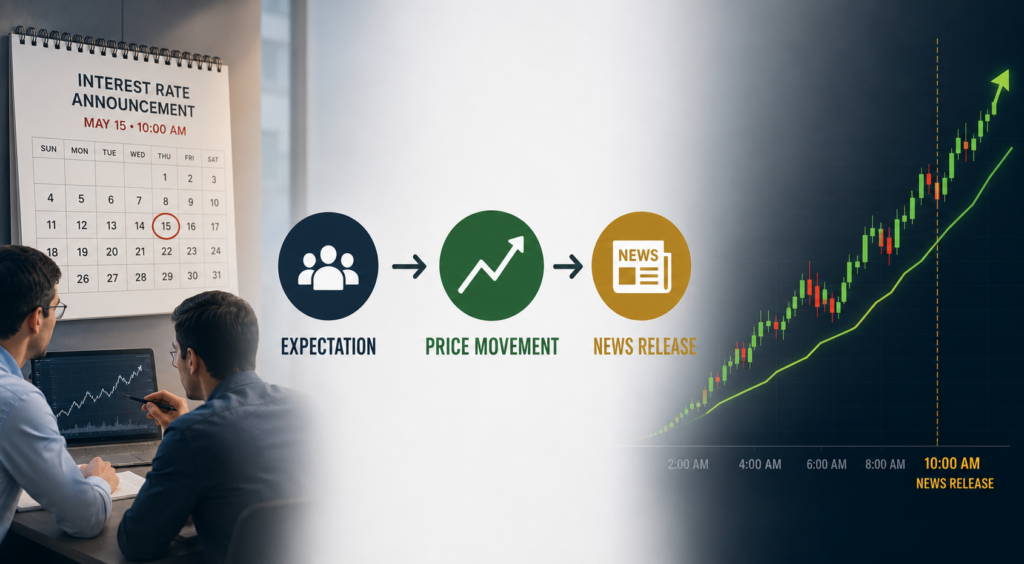
However, financial markets are not simply responding to today’s headlines. Markets are constantly trying to anticipate future events, and prices often reflect expectations long before news is officially released.
Financial markets frequently react to changes in expectations rather than the events themselves. This concept is supported by decades of economic research and forms the foundation of how modern financial markets operate.
As an educational company, our goal is to explain the forces behind market movements rather than predict future outcomes. Understanding the role of expectations, uncertainty, and investor psychology can help traders better understand why markets react unexpectedly and why volatility often emerges when expectations change.
If you’re new to trading and want to build a stronger foundation, visit our Beginner’s Area to learn the core principles behind how financial markets work.
Why Markets Often React Before the News Happens
One of the most important concepts in trading is that markets are forward-looking.
Understanding market expectations is a key part of reading price action. Our Trading Guides & Tutorials explain how traders use market information to make structured decisions.
Investors are constantly trying to anticipate future developments such as:
- Interest rates
- Inflation
- Economic growth
- Employment trends
- Government policy
As expectations change, prices adjust accordingly.
This means that by the time a major announcement is released, markets may have already factored much of that information into current prices.
For example, if traders strongly expect a central bank to raise interest rates, a large portion of that expectation may already be reflected in market prices before the official announcement takes place.
This idea is closely related to the Efficient Market Hypothesis, popularised by economist Eugene Fama, which suggests that financial markets rapidly incorporate available information into asset prices.
Further Reading:
Market Insight
The market often reacts not to the news itself, but to whether the news was better or worse than expected.
Why Markets React Unexpectedly: The Role of Expectations
Expectations help explain why markets sometimes move in surprising directions.
Imagine economists expect inflation to be 3%.
If inflation is reported at exactly 3%, markets may show little reaction because the result matched expectations.
However, if inflation is reported at 4%, investors may begin reassessing future interest rate expectations. This can lead to significant movements across currencies, stocks, bonds, and commodities.
The surprise is often more important than the actual number.
Learn how economic news events influence currencies, indices, and commodities in our Market Insights & Articles section.
Research from the Reserve Bank of Australia notes that financial markets primarily react to unexpected information because expected information has often already been incorporated into prices.
Further Reading:
Market Insight
Unexpected data often has a greater impact on markets than expected data.
Political Uncertainty and Market Volatility
Financial markets generally prefer certainty.
While investors may hold different opinions about government policies, markets tend to react when uncertainty increases.
Examples include:
- Elections
- Trade negotiations
- Tariff discussions
- Geopolitical tensions
- Fiscal policy changes
Investors closely monitor comments from political leaders, government officials, and central bankers because these statements can influence future economic growth, inflation, trade relationships, and monetary policy.
This helps explain why comments from influential figures can sometimes trigger immediate reactions in gold, oil, currencies, and stock markets.
Markets are not necessarily reacting to the statement itself. They are reacting to what that statement might mean for future economic conditions.
Market Insight
Markets dislike uncertainty because uncertainty makes future outcomes harder to evaluate.
Why Good News Can Sometimes Be Bad News
One of the most fascinating aspects of financial markets is that positive news does not always lead to positive market reactions.
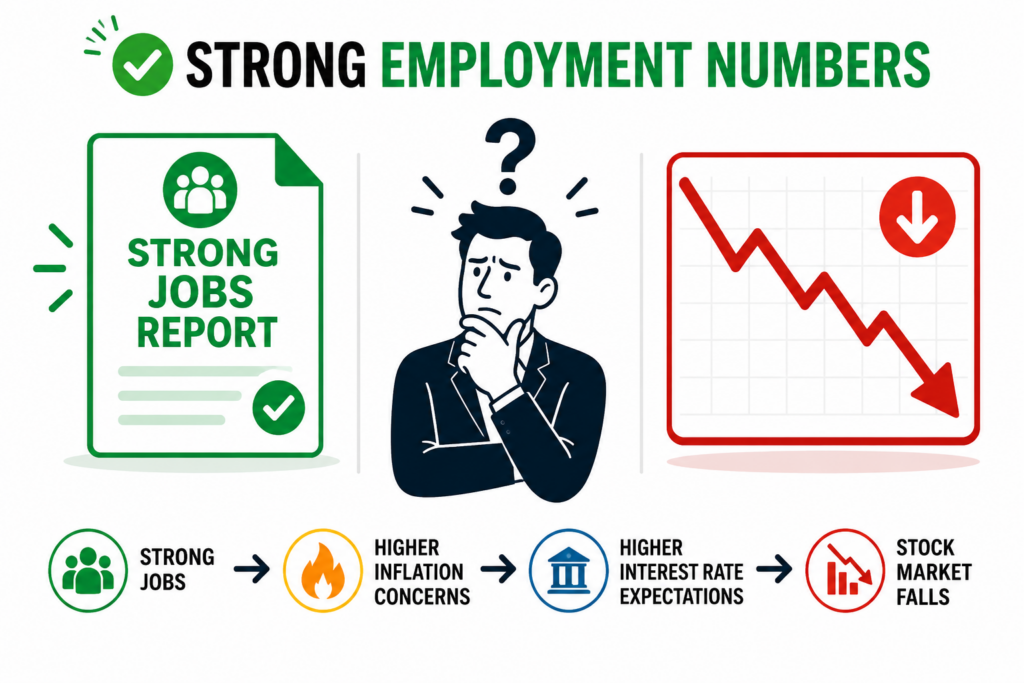
Consider a stronger-than-expected employment report.
At first glance, this appears positive for the economy. More jobs generally indicate economic strength.
However, stronger employment can also increase concerns about inflation. If investors believe inflation may rise, they may begin expecting higher interest rates from central banks.
Higher interest rates can increase borrowing costs, reduce spending, and place pressure on stock valuations.
As a result, stock markets may fall despite positive economic news.
The opposite can also occur.
Weak economic data may sometimes boost markets if investors believe central banks could lower interest rates or provide additional economic support.
This is why understanding expectations is often more important than understanding the headline itself.
Market Insight
What appears positive for the economy is not always positive for financial markets.
The Influence of Central Banks
Few institutions have a greater influence on financial markets than central banks.
Organisations such as the Federal Reserve, the European Central Bank, and the Bank of England play a major role in shaping economic conditions through monetary policy decisions.
Interest rates affect:
- Borrowing
- Spending
- Investment
- Economic growth
- Currency values
Because of this, traders closely watch central bank announcements, press conferences, and speeches for clues about future policy decisions.
Want to see how major economic events affect real markets? Explore the Encompass market simulation environment and practice without risking real capital.
In many cases, even subtle changes in language can trigger significant market volatility as investors adjust their expectations.
Research from the Federal Reserve Bank of San Francisco has shown that central bank communication can directly influence market expectations and inflation forecasts.
Further Reading:
Market Insight
Small changes in interest rate expectations can create significant market movements.
Understanding Market Psychology
While economic data and policy decisions are important, market psychology also plays a major role in price movements.
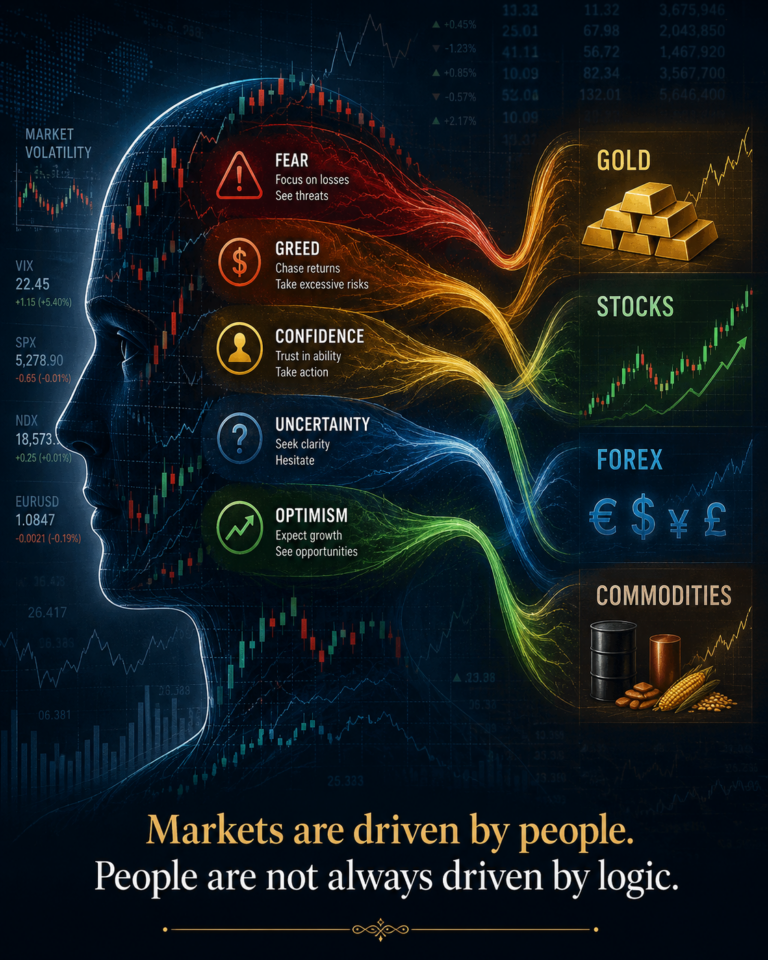
Markets are made up of people, and people are influenced by emotions.
Confidence, fear, uncertainty, and optimism can all affect how investors respond to new information.
During periods of uncertainty, investors may become more cautious and move capital into traditionally defensive assets such as gold.
During periods of confidence, investors may be more willing to take on risk.
Behavioural finance research has demonstrated that investor emotions and cognitive biases frequently influence market behaviour, particularly during periods of heightened uncertainty.
This psychological element helps explain why markets do not always react in a perfectly logical or predictable way.
Market Insight
Markets are driven by people, and people do not always react based on logic alone.
Looking Beyond the Headlines
Understanding why markets react unexpectedly requires looking beyond headlines and focusing on expectations, investor sentiment, central bank policy, and economic surprises. Financial markets are forward-looking by nature, which means prices often move based on what investors believe will happen next rather than what has already occurred.
Market movements may sometimes appear random, but they are often driven by a combination of expectations, economic data, policy decisions, and investor psychology.
Understanding these forces does not allow anyone to predict future market movements with certainty. However, it can help traders better understand why markets sometimes react in unexpected ways.
The next time markets move sharply following an economic report, political announcement, or central bank decision, it may be worth asking:
Was the market reacting to the event itself, or was it reacting to changing expectations about the future?
That question lies at the heart of understanding market behaviour.
Understanding why markets react unexpectedly is only the first step. Successful traders learn how to interpret economic data, manage risk, and develop a structured approach to decision-making.
Explore our Beginner’s Area, Trading Guides, and Market Simulation Tools to continue building your market knowledge in a practical, risk-free environment.
Key Takeaways From This Article
- Markets often react to expectations rather than events themselves.
- Economic surprises tend to have a greater impact than expected outcomes.
- Political uncertainty can increase market volatility.
- Good economic news does not always result in positive market reactions.
- Central bank expectations influence global financial markets.
- Market psychology plays an important role in price movements.
Disclaimer
This article is provided for educational purposes only. It does not constitute financial advice, trading advice, or investment recommendations. Financial markets involve risk, and past performance does not guarantee future results. Always conduct your own research and consider seeking professional advice where appropriate.