
Most investors don’t fail because the market is too complex.
They fail because they make it that way.
Spend five minutes looking at how people approach the market and you’ll notice a pattern: everything is heavier than it needs to be. Charts packed with indicators, constant news-checking, second-guessing every move. It looks serious. It looks professional. But more often than not, it’s just clutter.
The market isn’t simple, but it’s not nearly as complicated as people make it. The real issue is how investors respond to uncertainty. Instead of dealing with it, they try to eliminate it.
The Illusion of Complexity
There’s a quiet assumption that if money is involved, it must be complex. So beginners arrive expecting difficulty, and then build it for themselves. Add an indicator. Then another. Combine multiple strategies just to be safe. It feels responsible, like you’re covering all bases. In reality, you’re stacking opinions and calling it a plan.
Most tools don’t actually add new information. They simply repackage the same thing: price.
At their core, indicators are just different views of:
- Price movement
- Momentum
- Volatility
- Market structure
More input doesn’t lead to better decisions. More often, it just slows them down.
Why Investors Add Too Much
This isn’t really about strategy. It’s about discomfort. Nobody likes being wrong, especially when money is involved. So investors build layers into their decisions to soften the impact. If something goes wrong, there’s always something else to point to.
At the same time, people search for certainty. They want the market to behave like a formula, something predictable, something controllable. But markets don’t work like that. They’re driven by behavior, and behavior is messy.
There’s also influence. Spend enough time around trading content and you start to believe that complexity equals competence. Charts full of indicators look impressive, while clean charts can feel almost too simple to trust.
So people copy what looks advanced, not what actually works.
Why Simplicity Improves Decision-Making
When you strip things back, something interesting happens: decisions become clearer, faster, and easier to repeat.
A simple approach forces focus. Instead of juggling signals, you operate within a defined structure, one built on a few key variables and consistent rules.
That consistency is where progress comes from.
When you follow the same process repeatedly:
- Patterns become easier to recognize
- Mistakes become easier to identify
- Adjustments become more meaningful
Complex systems do the opposite. When every decision is based on a slightly different mix of inputs, there’s no clear feedback loop. Everything starts to feel random.
And when everything feels random, improvement becomes almost impossible.
Clutter vs Structure
Not all information is useful. Headlines, opinions, and predictions are often reactive. By the time they reach you, the move has already begun. Acting on them usually means you’re late. Structure is different. It’s a predefined way of operating, one that doesn’t change based on mood or noise.
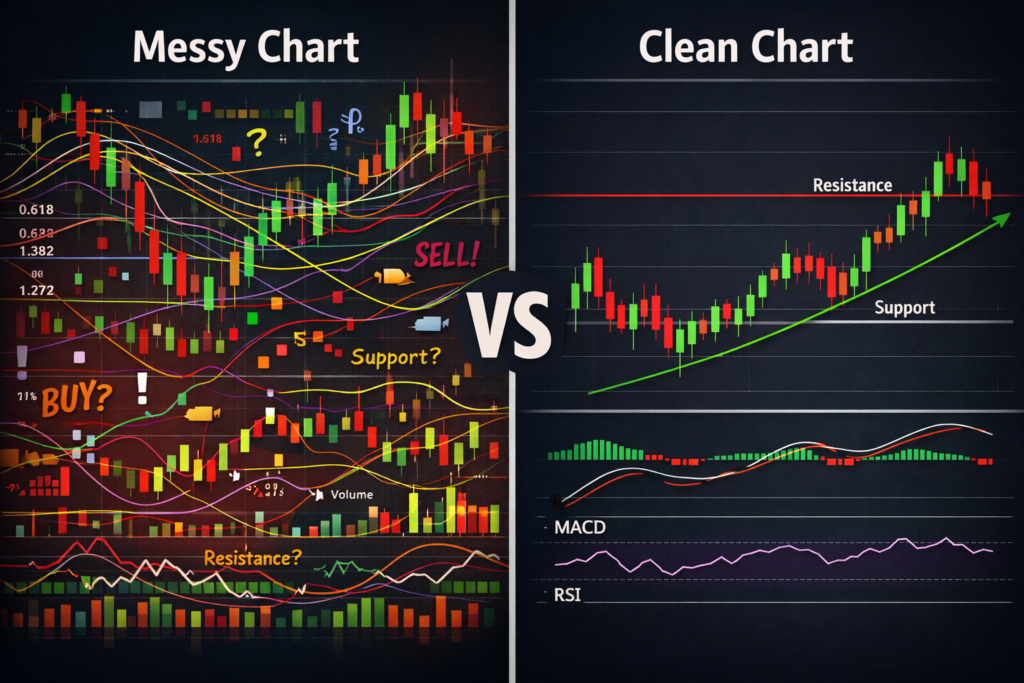
A solid structure typically includes:
- Clear rules
- Defined criteria
- Risk boundaries
The gap between clutter and structure is where most mistakes happen.
Investors react to noise instead of following a process. Every new piece of information becomes a reason to hesitate, adjust, or override their plan. Over time, consistency disappears, and with it, any real edge.
Why Beginners Chase “Perfect”
There’s a strong temptation to wait for everything to line up perfectly. Confirmation, agreement, clarity — no doubt, no ambiguity.
The problem is that markets rarely offer that kind of setup. And when they do, it’s usually obvious to everyone. So beginners wait. Then they hesitate. Then they chase. Eventually, frustration takes over, and decisions become forced rather than planned.
Consistency doesn’t look impressive, but it’s effective. It’s built on executing a solid approach repeatedly, even when conditions aren’t perfect. That’s where real results come from.
What Experienced Investors Do Differently
Experience tends to simplify things. Instead of chasing more information, seasoned investors narrow their focus. They pay attention to what actually moves the market and ignore most of the rest.
Their decisions are built around:
- Price behavior
- Trend direction
- Key levels
They operate within a framework, not a rigid script, but a consistent process that guides decisions over time. They also filter aggressively. Most information is ignored on purpose, not by accident. That restraint is where much of the edge comes from.
The Power of a Structured Approach
A structured approach removes unnecessary friction.
When decisions are based on predefined criteria, there’s less room for impulse and emotional reaction. You’re not responding to every movement, you’re responding to specific conditions.
It also makes your tools more effective. Instead of collecting indicators, each one has a clear role. If it doesn’t simplify the decision, it’s removed. Over time, this creates consistency. And consistency allows you to evaluate performance properly, what’s working, what isn’t, and what needs to change.
Without structure, you’re always starting over.
What Investors Should Focus On Instead
The shift isn’t complicated—but it does require discipline.
Focus on:
- Understanding how markets move (not predicting every move)
- Recognizing structure—trends, levels, and behavior
- Managing risk so no single decision carries too much weight
- Following a repeatable process
It won’t feel exciting. It won’t look impressive on a chart screenshot.
But it will keep you clear-headed, consistent, and far less likely to sabotage your own decisions.
Key Takeaways

- Complexity often hides uncertainty, not skill
- More indicators don’t improve decision-making
- Structure creates consistency and learning
- Markets reward discipline, not perfection
- Simplicity improves clarity, speed, and execution