

Why Share Prices Move:
The 5 Forces That Drive Stock Market Prices
If you spend enough time listening to beginner investors, you’ll hear the same complaint sooner or later. “The market makes no sense.”
One day a share shoots up like a springbok out the bush. The next day it falls flat on its face. Good news appears and the price drops. Bad news arrives and somehow the market rallies.
To the untrained eye, it all looks chaotic, but after more than forty years of watching markets, through crashes, booms, panics and the occasional moment of collective sanity, I can tell you something with confidence: Share prices are not random.
They move because thousands of investors are constantly reacting to information, expectations and emotion.
Once you understand what drives stock prices, the market stops looking like a casino and starts looking like a system.
Most movements in share prices come down to five powerful forces pushing and pulling the market every day.
What Makes Share Prices Go Up or Down?
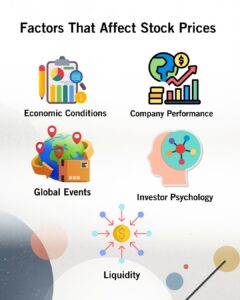
Share prices move because of five main forces:
- Company performance
- Economic conditions
- Global events
- Investor psychology
- Market liquidity
These forces interact constantly, shaping the price movements investors see in the stock market every day.
1. Company Performance
At the most basic level, a share represents ownership in a company.
When a business grows, earns more money, launches successful products or expands into new markets, investors become more interested in owning a piece of it.
That increased demand pushes the share price higher.
On the other hand, when a company stumbles, disappointing earnings, shrinking market share, operational problems, confidence fades. Investors begin selling their shares, and when sellers outnumber buyers, prices fall.
But here’s where many investors misunderstand how the market works.
The stock market does not simply react to results. It reacts to expectations.
A company can report excellent profits and still see its share price drop if investors expected even stronger results.
The market is always looking forward.
The share price today reflects what investors believe the company will look like months, sometimes years, into the future.
Beginners often analyze yesterday’s financial statements while the market is already debating tomorrow’s profits.
2. Economic Conditions
Companies do not operate in isolation. They exist within an economic environment that influences how they grow, borrow, spend and sell.
Economic factors that influence stock prices include:
- Interest rates
- Inflation
- Employment levels
- Economic growth
When interest rates rise, borrowing becomes more expensive for both companies and consumers. Businesses may slow expansion and consumers may reduce spending.
At the same time, investors may move some of their money out of shares and into safer income-producing investments such as bonds or savings accounts.
When the economy is growing strongly, the opposite tends to happen. Companies generate stronger earnings; consumer confidence improves and investors become more comfortable taking risks in the stock market.
In simple terms, the economy acts like the weather system surrounding businesses.
When the conditions are favorable, companies tend to thrive. When economic conditions weaken, markets often become more cautious.
3. Global Events
Modern financial markets are deeply interconnected.
Events taking place thousands of kilometers away can influence share prices locally within minutes.
Global factors that affect stock market prices include:
- Commodity price movements
- International trade policies
- Geopolitical tensions
- Central bank decisions
- Political events
For countries like South Africa, which rely heavily on commodity exports and international trade, these global forces can be particularly influential.
When commodities like gold, oil or platinum move sharply, mining and energy companies often follow. Political uncertainty or global conflicts can also change investor sentiment very quickly.
Markets constantly absorb new information from around the world and adjust prices accordingly.
Sometimes rationally. Sometimes… like a herd of nervous cattle running for the nearest gate.
4. Investor Psychology
Perhaps the most powerful force driving stock market prices is human behavior.
Markets are made up of people making decisions under uncertainty. And people are influenced by emotion just as much as logic.
When confidence is high, investors become optimistic. They are willing to pay higher prices because they believe the market will continue rising. But when fear spreads, the opposite happens.
Investors begin selling, sometimes all at once, which can cause share prices to fall far faster than company fundamentals alone would suggest. This emotional cycle is often described as the battle between fear and greed.
It is also one of the reasons markets can move further and faster than many investors expect.
Technical analysts study price charts precisely because they capture these shifts in investor psychology.
Often the chart begins to change before the headlines catch up.

5. The Hidden Force Many Investors Miss: Liquidity
There is one more force quietly shaping how share prices move.
Liquidity refers to how easily shares can be bought or sold in the market. Sometimes share prices move sharply not because of news or company performance, but because large investors are entering or exiting positions.
Institutional investors such as pension funds, asset managers and investment funds control enormous pools of capital.
When these institutions begin accumulating shares, prices can rise quickly. When they begin selling, prices can fall just as rapidly.
In other words, stock market prices are influenced not only by what investors believe, but also by how much money flows through the market at any given time.
Liquidity is the invisible tide lifting or lowering many stocks and it is one of the forces beginners often overlook.
Understanding What Drives the Market
Share prices move because of a complex interaction between several forces:
- Company performance
- Economic conditions
- Global developments
- Investor psychology
- Market liquidity
No single factor controls the market all the time. Instead, these forces interact continuously, creating the price movements investors see every day in the stock market.
For new investors, understanding what drives stock prices is the first step toward seeing the market more clearly.
At first the market may appear chaotic, but with experience and careful observation, patterns begin to emerge.
And that is when investing stops feeling like guessing and starts becoming a skill.
Frequently Asked Questions
Why do share prices change every day?
Share prices change because investors constantly buy and sell shares based on new information, expectations about the future, and changes in market sentiment.
What makes share prices go up?
Share prices rise when demand for the shares increases. This can happen due to strong company performance, positive economic conditions, or increased investor confidence.
What makes share prices fall?
Share prices fall when investors begin selling their shares, often due to negative company news, economic uncertainty, or shifts in market sentiment.
Do global events affect stock markets?
Yes. Political decisions, economic data, commodity prices and international events can all influence stock markets because investors react to new information that may affect company profits or economic growth.